SECONDAIRE
A Conceptual Exhibition on Originality, Repetition and Recognition
SECONDAIRE is a conceptual exhibition by Tatyana Sherstyuk exploring originality, repetition, authorship, image circulation and the economy of attention through a timed installation and performative visitor protocol.
Full exhibition concept available upon request.
SECONDAIRE
Original concept and text © Tatyana Sherstyuk
SECONDAIRE
Exhibitional Concept by Tatyana Sherstyuk
SECONDAIRE is a conceptual exhibition that examines originality not as an inherent artistic value, but as a historical and temporal construct. Instead of treating originality as invention, the project proposes it as a relative position within an ongoing cycle of repetition, translation, displacement, and return. It approaches this condition through irony, not as satire, but as a structural method for exposing how value, authorship, and attention are produced.
In a cultural condition defined by overproduction, the central problem is no longer the creation of new images, but the impossibility of fully assimilating those already in circulation. Images persist, migrate, and reappear under new conditions, while attention becomes increasingly fragmented and monetized. In this context, originality can no longer be understood as pure invention, but as recognition within time.
SECONDAIRE responds to this condition by proposing an exhibition not simply as a display of works, but as a temporal and spatial device for structuring attention. Rather than illustrating secondarity, the exhibition stages it. It creates an environment in which viewers do not pass from work to work, but enter a system of timed constellations where attention is measured, framed, and ritualized. In this way, the exhibition itself becomes the proposed solution to the problem it addresses: a constructed situation in which duration, recurrence, and spectatorship are made materially perceptible.
Time as Material
Each constellation is experienced through a limited temporal cycle. Sand timers function both as measurement and as irony: they quantify engagement while exposing the absurdity of quantifying thought. In a landscape defined by overproduction, time becomes the rarest resource. SECONDAIRE reframes attention as material.
Economy of Attention
The project introduces a symbolic intervention: viewers are “remunerated” for the time they dedicate to the exhibition. By making spectatorship visible as a transaction, SECONDAIRE questions the economy in which art circulates. The payment is not an incentive. It functions as a destabilizing institutional device that exposes the asymmetry between artistic production, spectatorship, and institutional value circulation.
Conceptual Position
SECONDAIRE is not an exhibition about plagiarism. It is about structural recurrence in art history and about the contemporary economy of attention. It situates originality not as an absolute value, but as a temporal position. By combining art-historical genealogies, spatial architecture, time-based protocols and a transactional model of spectatorship, the project proposes an exhibition format in which:
— time is visible;
— repetition is acknowledged;
— authorship is displaced;
— attention becomes material.
SECONDAIRE positions secondarity not as deficiency — but as the primary condition of contemporary form.
Exhibition Structure
SECONDAIRE is organized as seven spatial constellations, each examining a specific mode of artistic secondarity:
Quotation
Appropriation
Repetition
Parody / Irony
Remake
Translation
Pastiche
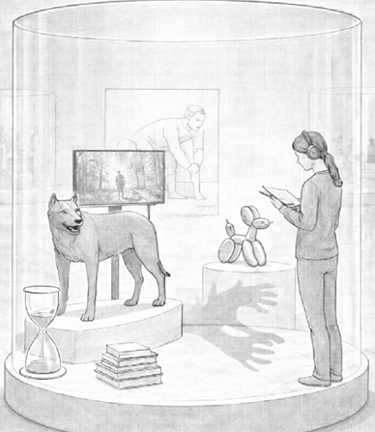
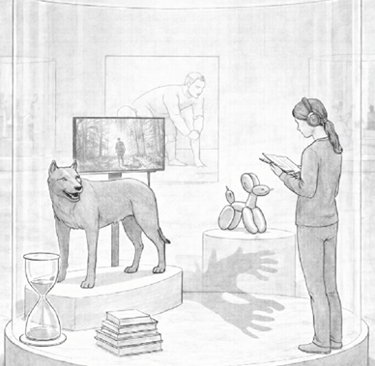
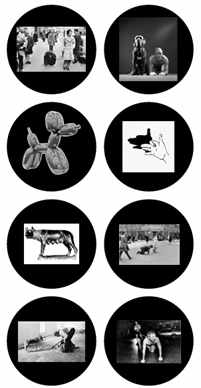
Each constellation brings together works from different historical periods — from Antiquity to contemporary practice — revealing genealogies of form rather than linear progressions. The display avoids hierarchy: works coexist within transparent cylindrical structures that function as spatial diagrams. Relationships become visible without asserting precedence. The display of the artworks inside of the constellations combines reproductions, projections and sculptural elements.
Visitor Protocol
The exhibition is experienced through timed cycles: viewers enter the constellations individually, move through them sequentially, and have their participation card perforated after each completed stage. A subtle sound signal and the turning of the hourglasses mark the beginning and end of each cycle. After completing the full route, visitors receive a token, which they may either keep or deposit in a collective container representing the circulation of attention.
Circular Arrangement of Timed Constellations
Visitors move through the exhibition one cylinder at a time in synchronized cycles, making attention, duration, and repetition physically perceptible.
Conceptual text by Tatyana Sherstyuk